Magnificat
or
Canticle of Mary
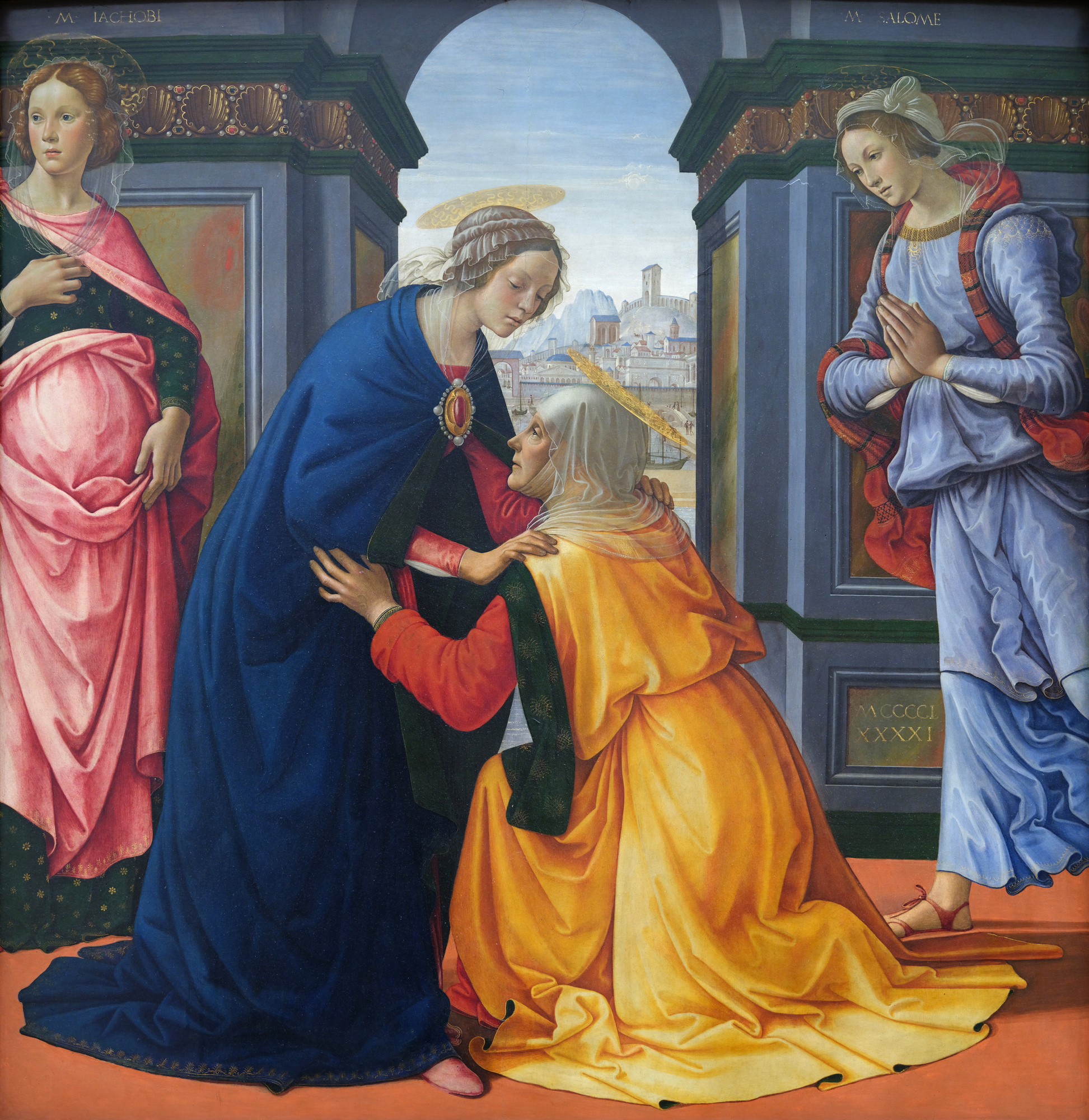
Visitation, Domenico Ghirlandaio, 1491
The Magnificat is the title commonly given to the Latin text and vernacular translation of the Canticle (or Song) of Mary. It is the opening word of the Vulgate text (Luke 1:46-55): "Magnificat anima mea, Dominum" (My soul doth magnify the Lord). In the Gospel of Luke 1:46-55 the events of the Visitation of the Blessed Virgin Mary to her cousin Elizabeth are recorded. Elizabeth, who was pregnant with John the Baptist at the time, greeted Mary with the well known phrase "Blessed art thou amongst women, blessed is the fruit of thy womb Jesus". Mary responded with the canticle.
In ancient antiphonaries it was often styled Evangelium Mariæ, the "Gospel of Mary". In the Roman Breviary it is entitled (Vespers for Sunday) Canticum B.M.V. (Canticle of the Blessed Virgin Mary). The Magnificat, Benedictus (Canticle of Zachary—Luke 1:68-79), and Nunc Dimittis (Canticle of Simeon—Luke 2:29-32) are also styled "evangelical canticles", as they are found in the Gospel (Evangelium) of St. Luke.
The Magnificat has occupied an important place in the Liturgy of the Church since around the fourth century. This canticle also provides the worshiper with the primary biblical example of what it is to venerate Mary. All generations will call her blessed, God has regarded her lowliness, he has magnified her. And all this is celebrated in the context of her role in God’s work of redemption: his ancient promises see their answer in her womb, in accordance with her faithfulness.
The Magnificat
My soul doth magnify the Lord,
and my spirit hath rejoiced in God my Saviour.
For He hath regarded the humility of His handmaiden.
For behold, from henceforth all generations shall call me blessed.
For He that is mighty hath done great things to me,
and holy is His Name.
And His Mercy is from generation unto generations
upon them that fear Him.
He hath shewed might in His arm,
He hath scattered the proud in the conceit of their heart.
He hath put down the mighty from their seat,
and hath exalted the humble.
He hath filled the hungry with good things, and the rich He hath sent empty away.
He hath received Israel, His servant,
being mindful of His mercy.
As He spoke to our Fathers,
Abraham and his seed forever.
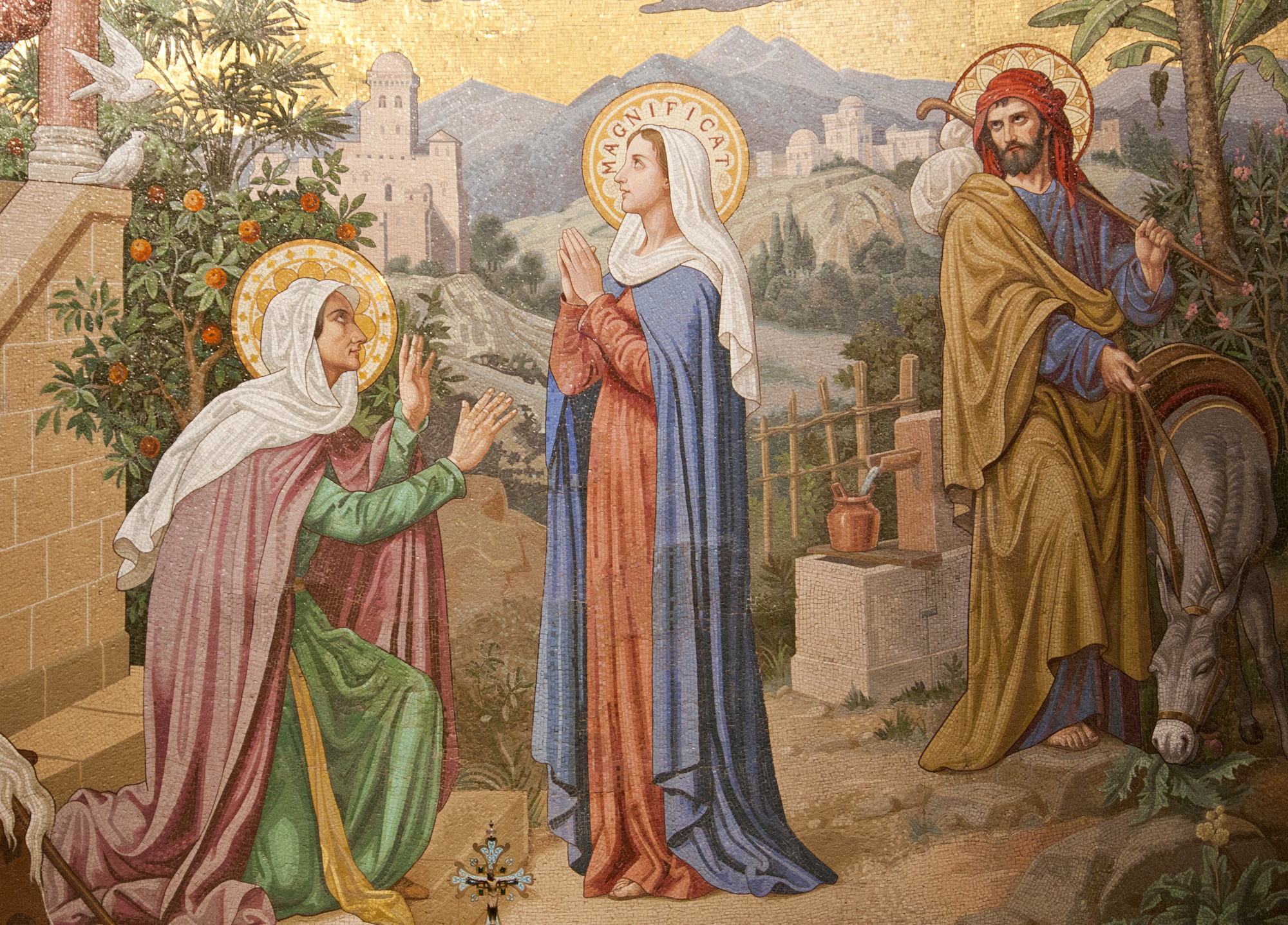
The Visitation, Mosaic, Rosary Basilica in Lourdes, France
Magnificat anima mea Dominum,
et exultavit spiritus meus in Deo salvatore meo,
quia respexit humilitatem ancillae suae.
Ecce enim ex hoc beatam me dicent omnes generationes,
quia fecit mihi magna, qui potens est,
et sanctum nomen eius,
et misericordia eius in progenies et progenies
timentibus eum.
Fecit potentiam in brachio suo,
dispersit superbos mente cordi sui;
deposuit potentes de sede
et exaltavit humiles;
esurientes implevit bonis
et divites dimisit inanes.
Suscepit Israel puerum suum,
recordatus misericordiae suae,
sicut locutus est ad patres nostros,
Abraham et semini eius in saecula.
There are many wonderful musical versions of the Magnificat. Claudio Monteverdi (1567- 1643) composed a Magnificat in the Vespers of the Blessed Virgin Mary in 1610. This piece performed by the Warsaw Philharmonic Choir (conducted by Henryk Wojnarowski) in November 2016 may be listened to here.
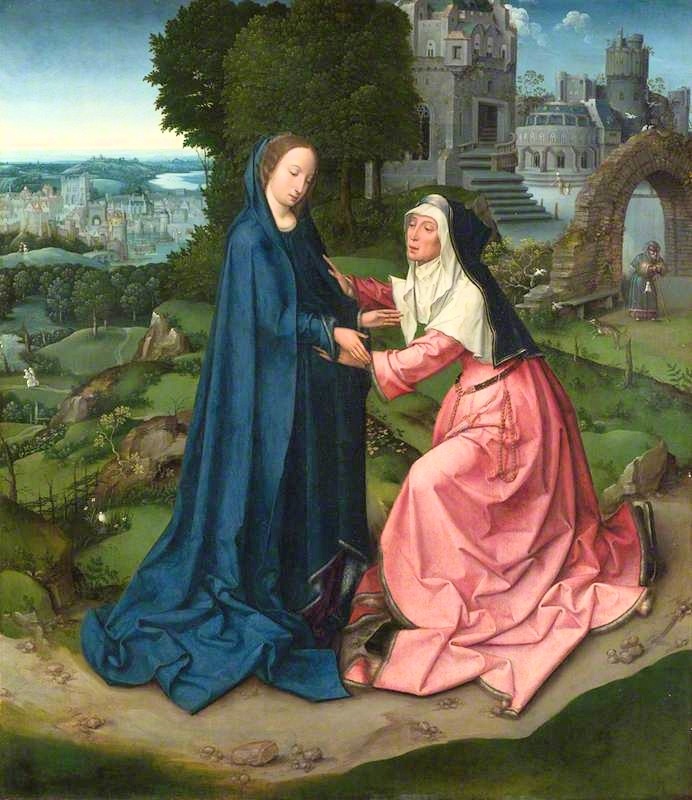
The Visitation of the Virgin to Saint Elizabeth, Workshop of Goossen van der Weyden, c. 1516
Immaculate Queen of Peace, pray for us.
